Buy kennzeichen24.eu ?
We are moving the project
kennzeichen24.eu .
Are you interested in purchasing the domain
kennzeichen24.eu ?
domain@kv-gmbh.de · 0541-91531010
Buy kennzeichen24.eu ?
What is the wave-particle duality?
Wave-particle duality is a fundamental concept in quantum mechanics that states that particles, such as electrons and photons, can exhibit both wave-like and particle-like behavior. This means that they can behave as waves, with characteristics such as interference and diffraction, and also as particles, with characteristics such as position and momentum. This duality challenges our classical understanding of particles and waves as distinct entities, and is a key aspect of understanding the behavior of matter and energy at the quantum level. **
Does the human have particle and wave characteristics?
Yes, humans and all matter have both particle and wave characteristics. This is known as wave-particle duality, a fundamental concept in quantum mechanics. At the quantum level, particles such as electrons and photons can exhibit wave-like behavior, as demonstrated by phenomena like diffraction and interference. This duality is a key aspect of the behavior of matter and energy at the smallest scales of the universe. **


Similar search terms for Wave-particle
Top-Angebote
Products related to Wave-particle:
-
Villeroy & Boch New Wave Pasta PlateExperience the delight of enjoying homemade pasta with the Villeroy & Boch New Wave Pasta Plate. This exquisite plate is part of the renowned New Wave collection, recognised for its unique asymmetrical shapes and graceful lines. Regardless of the occasion, this pasta plate offers a beautiful way to serve spaghetti, fusilli, and more. Crafted from premium porcelain, the Villeroy & Boch New Wave Pasta Plate is microwave and dishwasher safe. The plate's dimensions are L27.9cm x W27.9cm x H6.3cm.33,52 £*Shipping: 3,50 £Secure redirect to the provider
-
Villeroy & Boch New Wave Flat PlateEnhance your dining experience with the Villeroy & Boch New Wave Flat Plate. This elegant plate is a part of the renowned New Wave collection, celebrated for its distinctive asymmetrical shapes and graceful lines. This adaptable plate is suitable for casual lunches or brunches with friends. Crafted from premium porcelain, the Villeroy & Boch New Wave Flat Plate is safe to use in the microwave and dishwasher. The plate's dimensions are L27cm x W27cm x H2.4cm.29,52 £*Shipping: 3,50 £Secure redirect to the provider
-
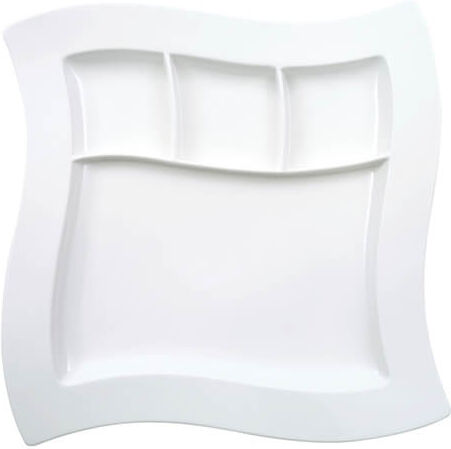
Villeroy & Boch New Wave Grill PlateIntroducing the Villeroy & Boch New Wave Grill Plate, the perfect addition to elevate your next barbecue experience. This exceptional grill plate, also known as a barbecue plate, is a part of the celebrated New Wave collection, known for its distinctive asymmetrical shapes and elegant lines. Designed to keep meat and sauces separate, this grill plate is crafted from premium porcelain and is both microwave and dishwasher safe. The plate measures L27cm x W27cm x H2.5cm.37,52 £*Shipping: 3,50 £Secure redirect to the provider
-
Villeroy & Boch New Wave Side PlateImpress your guests with the practical and beautiful Villeroy & Boch New Wave Side Plate. This delightful side plate is part of the celebrated New Wave collection, known for its distinctive asymmetrical shapes and elegant lines. Perfect for serving anything from cold meats and cheese to a side serving of bread, this side plate is crafted from premium porcelain and is both microwave and dishwasher safe. The plate measures L21.1cm x W14.4cm x H2.6cm.19,12 £*Shipping: 3,50 £Secure redirect to the provider



-
Do all quantum objects obey the wave-particle duality?
Yes, all quantum objects exhibit wave-particle duality, which means they can exhibit both wave-like and particle-like behavior. This duality is a fundamental aspect of quantum mechanics and is observed in phenomena such as the double-slit experiment, where particles exhibit interference patterns characteristic of waves. This duality is a key feature of quantum theory and is essential for understanding the behavior of quantum objects. **
-
What is the difference between the wave model and the particle model?
The wave model describes light as a wave that travels through space, exhibiting properties like interference and diffraction. In contrast, the particle model views light as a stream of particles called photons that carry energy and momentum. The wave model explains phenomena like interference patterns and polarization, while the particle model helps to understand effects like the photoelectric effect and Compton scattering. Both models are used in different contexts to describe the behavior of light. **
-
In which year and with which experiment was the wave-particle duality proven?
The wave-particle duality was proven in 1927 through the famous double-slit experiment conducted by physicist Thomas Young. This experiment demonstrated that light exhibits both wave-like and particle-like properties, leading to the development of the concept of wave-particle duality in quantum mechanics. **
-
What is the difference between the wave and the particle model of light?
The wave model of light describes light as a continuous wave with properties such as wavelength, frequency, and amplitude. This model explains phenomena such as interference and diffraction. On the other hand, the particle model of light, also known as the photon model, describes light as a stream of discrete particles called photons. This model explains phenomena such as the photoelectric effect and the emission of light from atoms. The wave model is more suitable for explaining the behavior of light in certain situations, while the particle model is more suitable for explaining other phenomena. **

How can one imagine a photon within the framework of wave-particle duality?
Within the framework of wave-particle duality, a photon can be imagined as both a wave and a particle simultaneously. As a wave, it exhibits properties such as interference and diffraction, similar to other waves. As a particle, it carries discrete packets of energy and momentum, and can interact with matter as a discrete entity. This duality means that a photon's behavior is best described by both wave and particle characteristics, and it can exhibit wave-like behavior in some situations and particle-like behavior in others. This dual nature of a photon is a fundamental aspect of quantum mechanics. **
Light is neither a particle nor a wave, but depending on the experiment it exhibits properties of either a wave or a particle. But what it really is, we do not know.
Light is a complex phenomenon that exhibits both wave-like and particle-like properties. In some experiments, it behaves like a wave, showing interference and diffraction patterns, while in others, it behaves like a particle, interacting with matter in discrete packets of energy called photons. The true nature of light remains a mystery, and it is described by the wave-particle duality principle in quantum mechanics. **
Top-Angebote
Products related to Wave-particle:
-
Villeroy & Boch New Wave Gourmet PlateEnjoy moments of indulgence in a new way with the Villeroy & Boch New Wave Gourmet Plate. This exquisite plate is part of the renowned New Wave collection, recognised for its unique asymmetrical shapes and graceful lines. This large, practical plate is perfect as an original underplate for a meal or for serving special delicacies. Crafted from premium porcelain, the Villeroy & Boch New Wave Gourmet Plate is microwave and dishwasher safe. The plate's dimensions are L33cm x W24cm x H3.5cm.33,52 £*Shipping: 3,50 £Secure redirect to the provider
-
Villeroy & Boch New Wave Soup PlateEnhance your dining experience with the Villeroy & Boch New Wave Soup Plate. This exquisite plate is part of the renowned New Wave collection, recognised for its unique asymmetrical shapes and graceful lines. This soup plate is perfect for all kinds of soups, from chilled Gazpacho to hearty, warming stews. Crafted from premium porcelain, the Villeroy & Boch New Wave Soup Plate is microwave and dishwasher safe. The plate's dimensions are L24.5cm x W24.5cm x H4.5cm.29,52 £*Shipping: 3,50 £Secure redirect to the provider
-
Villeroy & Boch New Wave Pasta PlateExperience the delight of enjoying homemade pasta with the Villeroy & Boch New Wave Pasta Plate. This exquisite plate is part of the renowned New Wave collection, recognised for its unique asymmetrical shapes and graceful lines. Regardless of the occasion, this pasta plate offers a beautiful way to serve spaghetti, fusilli, and more. Crafted from premium porcelain, the Villeroy & Boch New Wave Pasta Plate is microwave and dishwasher safe. The plate's dimensions are L27.9cm x W27.9cm x H6.3cm.33,52 £*Shipping: 3,50 £Secure redirect to the provider
-
Villeroy & Boch New Wave Flat PlateEnhance your dining experience with the Villeroy & Boch New Wave Flat Plate. This elegant plate is a part of the renowned New Wave collection, celebrated for its distinctive asymmetrical shapes and graceful lines. This adaptable plate is suitable for casual lunches or brunches with friends. Crafted from premium porcelain, the Villeroy & Boch New Wave Flat Plate is safe to use in the microwave and dishwasher. The plate's dimensions are L27cm x W27cm x H2.4cm.29,52 £*Shipping: 3,50 £Secure redirect to the provider
-
What is the wave-particle duality?
Wave-particle duality is a fundamental concept in quantum mechanics that states that particles, such as electrons and photons, can exhibit both wave-like and particle-like behavior. This means that they can behave as waves, with characteristics such as interference and diffraction, and also as particles, with characteristics such as position and momentum. This duality challenges our classical understanding of particles and waves as distinct entities, and is a key aspect of understanding the behavior of matter and energy at the quantum level. **
-
Does the human have particle and wave characteristics?
Yes, humans and all matter have both particle and wave characteristics. This is known as wave-particle duality, a fundamental concept in quantum mechanics. At the quantum level, particles such as electrons and photons can exhibit wave-like behavior, as demonstrated by phenomena like diffraction and interference. This duality is a key aspect of the behavior of matter and energy at the smallest scales of the universe. **
-
Do all quantum objects obey the wave-particle duality?
Yes, all quantum objects exhibit wave-particle duality, which means they can exhibit both wave-like and particle-like behavior. This duality is a fundamental aspect of quantum mechanics and is observed in phenomena such as the double-slit experiment, where particles exhibit interference patterns characteristic of waves. This duality is a key feature of quantum theory and is essential for understanding the behavior of quantum objects. **
-
What is the difference between the wave model and the particle model?
The wave model describes light as a wave that travels through space, exhibiting properties like interference and diffraction. In contrast, the particle model views light as a stream of particles called photons that carry energy and momentum. The wave model explains phenomena like interference patterns and polarization, while the particle model helps to understand effects like the photoelectric effect and Compton scattering. Both models are used in different contexts to describe the behavior of light. **
Similar search terms for Wave-particle
-
Villeroy & Boch New Wave Grill PlateIntroducing the Villeroy & Boch New Wave Grill Plate, the perfect addition to elevate your next barbecue experience. This exceptional grill plate, also known as a barbecue plate, is a part of the celebrated New Wave collection, known for its distinctive asymmetrical shapes and elegant lines. Designed to keep meat and sauces separate, this grill plate is crafted from premium porcelain and is both microwave and dishwasher safe. The plate measures L27cm x W27cm x H2.5cm.37,52 £*Shipping: 3,50 £Secure redirect to the provider
-
Villeroy & Boch New Wave Side PlateImpress your guests with the practical and beautiful Villeroy & Boch New Wave Side Plate. This delightful side plate is part of the celebrated New Wave collection, known for its distinctive asymmetrical shapes and elegant lines. Perfect for serving anything from cold meats and cheese to a side serving of bread, this side plate is crafted from premium porcelain and is both microwave and dishwasher safe. The plate measures L21.1cm x W14.4cm x H2.6cm.19,12 £*Shipping: 3,50 £Secure redirect to the provider
-
Villeroy & Boch New Wave Buffet PlateExperience moments of indulgence with the Villeroy & Boch New Wave Buffet Plate. This elegant plate is part of the renowned New Wave collection, known for its distinct asymmetrical shapes and graceful lines. This large, practical plate is perfect as an original underplate for a meal or for serving special delicacies. Made from premium porcelain, the Villeroy & Boch New Wave Buffet Plate is microwave and dishwasher safe. The plate's dimensions are L37.4cm x W24.9cm x H3.6cm.33,52 £*Shipping: 3,50 £Secure redirect to the provider
-
Villeroy & Boch New Wave Antipasti PlateSpoil your guests Italian-style with the Villeroy & Boch New Wave Antipasti Plate. This stylish antipasti plate is part of the popular New Wave collection, known for its unique asymmetrical shapes and fluid lines. Use this antipasti plate to add a special touch when serving delicious appetisers. Made from premium porcelain, the Villeroy & Boch New Wave Antipasti Plate is safe for use in both the microwave and dishwasher. The serving dish measures L42.3cm x W14.8cm x H3.5cm.22,32 £*Shipping: 3,50 £Secure redirect to the provider
-
In which year and with which experiment was the wave-particle duality proven?
The wave-particle duality was proven in 1927 through the famous double-slit experiment conducted by physicist Thomas Young. This experiment demonstrated that light exhibits both wave-like and particle-like properties, leading to the development of the concept of wave-particle duality in quantum mechanics. **
-
What is the difference between the wave and the particle model of light?
The wave model of light describes light as a continuous wave with properties such as wavelength, frequency, and amplitude. This model explains phenomena such as interference and diffraction. On the other hand, the particle model of light, also known as the photon model, describes light as a stream of discrete particles called photons. This model explains phenomena such as the photoelectric effect and the emission of light from atoms. The wave model is more suitable for explaining the behavior of light in certain situations, while the particle model is more suitable for explaining other phenomena. **
-
How can one imagine a photon within the framework of wave-particle duality?
Within the framework of wave-particle duality, a photon can be imagined as both a wave and a particle simultaneously. As a wave, it exhibits properties such as interference and diffraction, similar to other waves. As a particle, it carries discrete packets of energy and momentum, and can interact with matter as a discrete entity. This duality means that a photon's behavior is best described by both wave and particle characteristics, and it can exhibit wave-like behavior in some situations and particle-like behavior in others. This dual nature of a photon is a fundamental aspect of quantum mechanics. **
-
Light is neither a particle nor a wave, but depending on the experiment it exhibits properties of either a wave or a particle. But what it really is, we do not know.
Light is a complex phenomenon that exhibits both wave-like and particle-like properties. In some experiments, it behaves like a wave, showing interference and diffraction patterns, while in others, it behaves like a particle, interacting with matter in discrete packets of energy called photons. The true nature of light remains a mystery, and it is described by the wave-particle duality principle in quantum mechanics. **
* All prices are inclusive of VAT and, if applicable, plus shipping costs. The offer information is based on the details provided by the respective shop and is updated through automated processes. Real-time updates do not occur, so deviations can occur in individual cases. ** Note: Parts of this content were created by AI.