Buy kennzeichen24.eu ?
We are moving the project
kennzeichen24.eu .
Are you interested in purchasing the domain
kennzeichen24.eu ?
domain@kv-gmbh.de · 0541-91531010
Buy kennzeichen24.eu ?
What is the license plate number of the dented car?
Sorry, I cannot provide the license plate number of the dented car as it would be considered personally identifiable information. **
What is the registration number for the license plate?
I'm sorry, but I cannot provide specific information such as registration numbers for license plates. This information is considered sensitive and private, and it is important to respect individuals' privacy and confidentiality. If you have any other questions or need assistance with something else, feel free to ask. **


Similar search terms for Pan-The-Psychology-of
Top-Angebote
Products related to Pan-The-Psychology-of:
-
Pan Macmillan UK Ltd The Psychology Of Money, The Art of Spending Money and Same as Ever by Morgan Housel 3 Books Collection SetThe Psychology Of Money, The Art of Spending Money and Same as Ever by Morgan Housel 3 Books Collection Set Titles in this set: 1. Same as Ever 2. The Psychology of Money 3. The Art of Spending Money Description: Same as Ever When planning for the future we often ask, “What will the economy be doing this time next year?” Or, “What will be different ten years from now?” But forecasting is hard. The important events that will shape the future are inherently unpredictable. Instead, we should be asking a different question: What will be the same ten years from now? What will be the same one hundred years from now? Knowledge of the things that never change is more useful, and more important, than an uncertain prediction of an unknowable future. In Same As Ever, bestselling author Morgan Housel shares 24 short stories about the ways that life, behaviour, and business will always be the same. Armed with this knowledge of the unchanging, you will have a powerful new ability to think about risk, opportunity, and how to navigate the uncertainty of the future. The Psychology of Money Doing well with money isn't necessarily about what you know. It's about how you behave. And behavior is hard to teach, even to really smart people. Money investing, personal finance, and business decisions is typically taught as a math-based field, where data and formulas tell us exactly what to do. But in the real world people don't make financial decisions on a spreadsheet. They make them at the dinner table, or in a meeting room, where personal history, your own unique view of the world, ego, pride, marketing, and odd incentives are scrambled together. In The Psychology of Money, award-winning author Morgan Housel shares 19 short stories exploring the strange ways people think about money and teaches you how to make better sense of one of life's most important topics. The Art of Spending Money Can money buy happiness? Yes. Can spending it make you happier? Absolutely. Yet, many of us struggle to unlock its full potential – either by spending on things that don't bring as much joy as they should, or by avoiding investments that would truly enhance our mental well-being. In The Art of Spending Money, award-winning and global bestselling author Morgan Housel offers a refreshingly practical approach to managing wealth while finding deeper meaning and contentment. Instead of cookie-cutter financial advice, Housel provides you with psychological tools to navigate your personal relationship with money and optimise for happiness. Discover why people often mistake envy for admiration, how to align your expectations with your income, and ways to invest in future happiness while avoiding regret. Learn about the dangers of social debt and embrace the radical idea that the fastest way to build wealth is by going slow. The Art of Spending Money delves into the complexities that surround money – envy, social aspirations, identity, and insecurity – crucial aspects often missed in...24,99 £*Shipping: 2,99 £Secure redirect to the provider
-
The Little Book of Psychology (DK Big Ideas Series)How does the brain remember faces? What makes us choose one decision over another? Where does language come from? Can we really measure intelligence? DK's The Little Book of Psychology answers all these questions and provides an insight into this fascinating field of science. Whether you are a student, an expert, a novice, or have a general interest in the human mind, this portable guide is the perfect choice to start exploring and understanding psychology. From cognitive to behavioural psychology, this stimulating guide covers all major schools in the field. It includes doctrines and quotes from major thinkers including Sigmund Freud, Noam Chomsky, and Kurt Lewin. Small biography boxes provide brief biographical details of all the thinkers. With the use of powerful and witty illustrations and easy and jargon-free explanations, The Little Book of Psychology demystifies hard-to-grasp concepts and shows how these ideas have shaped our knowledge of the human mind.5,99 £*Shipping: 2,99 £Secure redirect to the provider
-
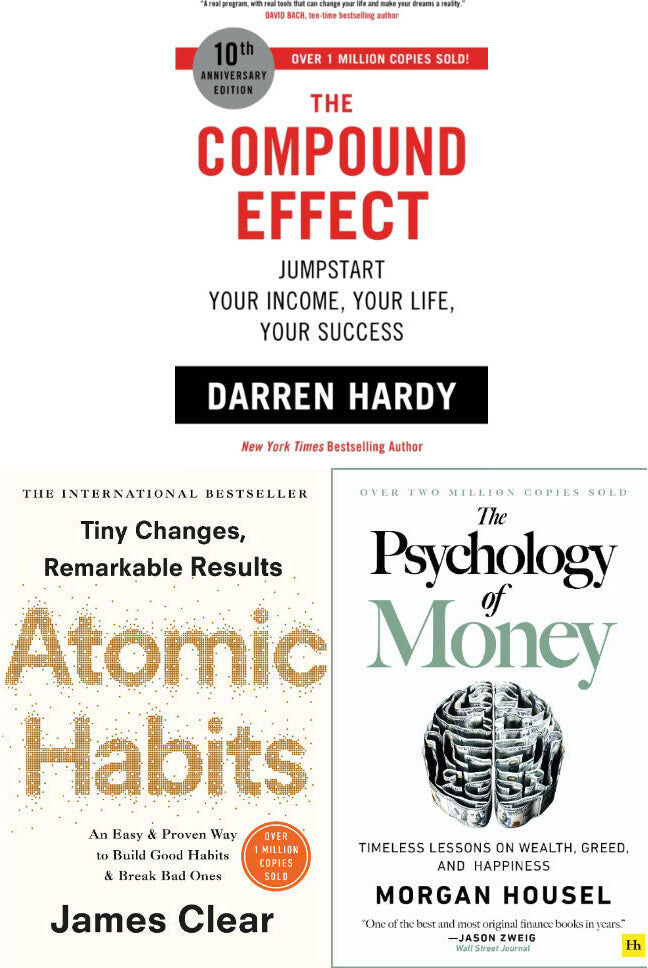
Harriman House Atomic Habits, The Compound Effect, The Psychology of Money 3 Books Collection SetAtomic Habits People think that when you want to change your life, you need to think big. But world-renowned habits expert James Clear has discovered another way. He knows that real change comes from the compound effect of hundreds of small decisions: doing two push-ups a day, waking up five minutes early, or holding a single short phone call. The Compound Effect As the central curator of the success media industry for over 25 years, author Darren Hardy has heard it all, seen it all, and tried most of it. This book reveals the core principles that drive success. The Compound Effect contains the essence of what every superachiever needs to know, practice, and master to obtain extraordinary success. Inside you will find strategies on: How to win--every time! The Psychology of Money Doing well with money isn't necessarily about what you know. It's about how you behave. And behavior is hard to teach, even to really smart people. Money investing, personal finance, and business decisions is typically taught as a math-based field, where data and formulas tell us exactly what to do. But in the real world people don't make financial decisions on a spreadsheet.22,95 £*Shipping: 2,99 £Secure redirect to the provider
-
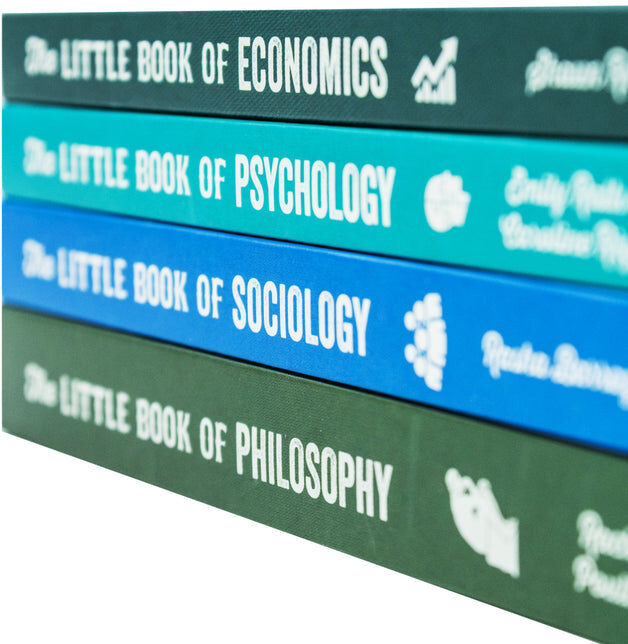
Summersdale Publishers The Little Book of Philosophy, Sociology, Economics & Psychology 4 Books Collection SetThe Little Book of Philosophy Philosophy is a quest for wisdom and knowledge; philosophia in Ancient Greek literally means “love of wisdom”. The aim of philosophy is to ask and explore life’s big questions to help us work out what we can know and how we can live a good life. Today, in a world of fake news, embarking on a quest for truth couldn’t be more important. The Little Book of Sociology From the smallest everyday interaction to the impact of vast systemic change, societies are brimming with fascinating phenomena we all want to understand more clearly.There's never been a more important moment to grasp what's going on around us, and this pocket-sized guide offers an engaging introduction to the key sociological concepts. The Little Book of Economics This Book will bring you up to speed on the basics of micro- and macroeconomics and demystify the world of taxes, trade, investments and finance, in simple English and with easy-to-follow examples.By the end of this crash course, you will have a grasp on all the essential terms, concepts and theories you need to know to understand modern-day. The Little Book of Psychology If you want to know your Freud from your Jung and your Milgram from your Maslow, strap in for this whirlwind tour of the highlights of psychology. Including accessible primers on: - The early thinkers who contributed to psychological ideas and the birth of modern psychology- Famous (and often controversial) experiments and their repercussions.12,99 £*Shipping: 2,99 £Secure redirect to the provider


-
Movies of Peter Pan
There have been several movies made about Peter Pan, a character created by J.M. Barrie. The most famous adaptation is Disney's animated film "Peter Pan" released in 1953, which follows the story of Peter Pan, Wendy, Tinker Bell, and the Lost Boys in Neverland. Another well-known adaptation is the 2003 live-action film "Peter Pan" directed by P.J. Hogan, which starred Jeremy Sumpter as Peter Pan and Jason Isaacs as Captain Hook. These movies have become beloved classics and continue to enchant audiences of all ages with the timeless tale of the boy who never grows up. **
-
'Movies of Peter Pan'
There have been several movies based on the character of Peter Pan, the most famous being the 1953 animated Disney film. This classic movie follows the story of Peter Pan, a boy who never grows up, and his adventures in Neverland with Wendy, John, Michael, and the Lost Boys. Other notable adaptations include the 1991 film "Hook" starring Robin Williams as a grown-up Peter Pan, and the 2003 live-action film "Peter Pan" directed by P.J. Hogan. These movies continue to captivate audiences with their timeless tale of magic, adventure, and the power of imagination. **
-
How can I deregister my car if I don't have the vehicle registration document or the license plate?
If you don't have the vehicle registration document or license plate, you can still deregister your car by contacting your local Department of Motor Vehicles (DMV) or equivalent authority. You will likely need to provide alternative forms of identification and proof of ownership, such as a bill of sale or a notarized affidavit. The DMV will guide you through the process and may require additional documentation to complete the deregistration. It's important to follow the specific instructions provided by the DMV to ensure the proper deregistration of your vehicle. **
-
What is the significance of the number 10062 in psychology?
In psychology, the number 10062 is significant as it is the number of different possible 5-item scales that can be created from a pool of 20 items. This concept is important in understanding the complexity and variability of psychological measurement. It highlights the vast number of potential combinations and permutations that can be used to assess psychological constructs, emphasizing the need for careful selection and validation of measurement tools in psychological research and practice. **
What is the significance of the number 10035 in psychology?
In psychology, the number 10035 is significant because it is the code for the DSM-5 diagnosis of Posttraumatic Stress Disorder (PTSD). The DSM-5 is the Diagnostic and Statistical Manual of Mental Disorders, which is used by mental health professionals to diagnose and classify mental disorders. PTSD is a serious mental health condition that can develop after a person has been exposed to a traumatic event, and the DSM-5 code 10035 is used to identify and diagnose individuals who exhibit the symptoms of PTSD. Therefore, the number 10035 holds significance in psychology as it represents a specific diagnosis within the field of mental health. **
Is the car registration plate ST 09 in the middle of the plate not made up of letters and not a government vehicle?
The car registration plate ST 09 is not in the middle of the plate and is made up of letters and numbers, so it is not a government vehicle. The registration plate appears to be a standard civilian vehicle registration plate. **
Top-Angebote
Products related to Pan-The-Psychology-of:
-
Pan The Psychology of Stupidity: Explained by Some of the World's Smartest People by Jean-Francois MarmionThe Psychology of Stupidity: Explained by Some of the World's Smartest People At last, stupidity explained! And by some of the world’s smartest people, among them Daniel Kahneman, Dan Ariely, Alison Gopnik, Howard Gardner, Antonio Damasio, Aaron James and Ryan Holiday. Stupidity is all around us, from the colleagues who won’t stop hitting ‘reply all’ to the former school friends posting conspiracy theories on Facebook. But in order to battle idiocy, we must first understand it. In The Psychology of Stupidity, some of the world’s leading psychologists and thinkers – including a Nobel Prize winner – will show you . . . · Why smart people sometimes believe in utter nonsense· How our lazy brains cause us to make the wrong decisions· Why trying to debate with fools is a trap· How media manipulation and Internet overstimulation makes us dumber· Why the stupidest people don’t think they’re stupidAs long as there have been humans there has been human stupidity, but with wit and wisdom these great thinkers can help us understand this persistent human affliction.2,99 £*Shipping: 1,99 £Secure redirect to the provider
-
The Psychology Of Money, The Art of Spending Money & Same as Ever by Morgan Housel 3 Books Collection Set - Non Fiction - Paperback Pan MacmillanTitles in this set: 1. Same as Ever 2. The Psychology of Money 3. The Art of Spending Money Description: Same as Ever When planning for the future we often ask, “What will the economy be doing this time next year?” Or, “What will be different ten years from now?” But forecasting is hard. The important events that will shape the future are inherently unpredictable. Instead, we should be asking a different question: What will be the same ten years from now? What will be the same one hundred years from now? Knowledge of the things that never change is more useful, and more important, than an uncertain prediction of an unknowable future. In Same As Ever, bestselling author Morgan Housel shares 24 short stories about the ways that life, behaviour, and business will always be the same. Armed with this knowledge of the unchanging, you will have a powerful new ability to think about risk, opportunity, and how to navigate the uncertainty of the future. The Psychology of Money Doing well with money isn't necessarily about what you know. It's about how you behave. And behavior is hard to teach, even to really smart people. Money investing, personal finance, and business decisions is typically taught as a math-based field, where data and formulas tell us exactly what to do. But in the real world people don't make financial decisions on a spreadsheet. They make them at the dinner table, or in a meeting room, where personal history, your own unique view of the world, ego, pride, marketing, and odd incentives are scrambled together. In The Psychology of Money, award-winning author Morgan Housel shares 19 short stories exploring the strange ways people think about money and teaches you how to make better sense of one of life's most important topics. The Art of Spending Money Can money buy happiness? Yes. Can spending it make you happier? Absolutely. Yet, many of us struggle to unlock its full potential – either by spending on things that don't bring as much joy as they should, or by avoiding investments that would truly enhance our mental well-being. In The Art of Spending Money, award-winning and global bestselling author Morgan Housel offers a refreshingly practical approach to managing wealth while finding deeper meaning and contentment. Instead of cookie-cutter financial advice, Housel provides you with psychological tools to navigate your personal relationship with money and optimise for happiness. Discover why people often mistake envy for admiration, how to align your expectations with your income, and ways to invest in future happiness while avoiding regret. Learn about the dangers of social debt and embrace the radical idea that the fastest way to build wealth is by going slow. The Art of Spending Money delves into the complexities that surround money – envy, social aspirations, identity, and insecurity – crucial aspects often missed in traditional financial books. Armed with new insights into money and wealth, you’ll learn to sidestep common spending...26,99 £*Shipping: 2,99 £Secure redirect to the provider
-
Pan Macmillan UK Ltd The Psychology Of Money, The Art of Spending Money and Same as Ever by Morgan Housel 3 Books Collection SetThe Psychology Of Money, The Art of Spending Money and Same as Ever by Morgan Housel 3 Books Collection Set Titles in this set: 1. Same as Ever 2. The Psychology of Money 3. The Art of Spending Money Description: Same as Ever When planning for the future we often ask, “What will the economy be doing this time next year?” Or, “What will be different ten years from now?” But forecasting is hard. The important events that will shape the future are inherently unpredictable. Instead, we should be asking a different question: What will be the same ten years from now? What will be the same one hundred years from now? Knowledge of the things that never change is more useful, and more important, than an uncertain prediction of an unknowable future. In Same As Ever, bestselling author Morgan Housel shares 24 short stories about the ways that life, behaviour, and business will always be the same. Armed with this knowledge of the unchanging, you will have a powerful new ability to think about risk, opportunity, and how to navigate the uncertainty of the future. The Psychology of Money Doing well with money isn't necessarily about what you know. It's about how you behave. And behavior is hard to teach, even to really smart people. Money investing, personal finance, and business decisions is typically taught as a math-based field, where data and formulas tell us exactly what to do. But in the real world people don't make financial decisions on a spreadsheet. They make them at the dinner table, or in a meeting room, where personal history, your own unique view of the world, ego, pride, marketing, and odd incentives are scrambled together. In The Psychology of Money, award-winning author Morgan Housel shares 19 short stories exploring the strange ways people think about money and teaches you how to make better sense of one of life's most important topics. The Art of Spending Money Can money buy happiness? Yes. Can spending it make you happier? Absolutely. Yet, many of us struggle to unlock its full potential – either by spending on things that don't bring as much joy as they should, or by avoiding investments that would truly enhance our mental well-being. In The Art of Spending Money, award-winning and global bestselling author Morgan Housel offers a refreshingly practical approach to managing wealth while finding deeper meaning and contentment. Instead of cookie-cutter financial advice, Housel provides you with psychological tools to navigate your personal relationship with money and optimise for happiness. Discover why people often mistake envy for admiration, how to align your expectations with your income, and ways to invest in future happiness while avoiding regret. Learn about the dangers of social debt and embrace the radical idea that the fastest way to build wealth is by going slow. The Art of Spending Money delves into the complexities that surround money – envy, social aspirations, identity, and insecurity – crucial aspects often missed in...24,99 £*Shipping: 2,99 £Secure redirect to the provider
-
The Little Book of Psychology (DK Big Ideas Series)How does the brain remember faces? What makes us choose one decision over another? Where does language come from? Can we really measure intelligence? DK's The Little Book of Psychology answers all these questions and provides an insight into this fascinating field of science. Whether you are a student, an expert, a novice, or have a general interest in the human mind, this portable guide is the perfect choice to start exploring and understanding psychology. From cognitive to behavioural psychology, this stimulating guide covers all major schools in the field. It includes doctrines and quotes from major thinkers including Sigmund Freud, Noam Chomsky, and Kurt Lewin. Small biography boxes provide brief biographical details of all the thinkers. With the use of powerful and witty illustrations and easy and jargon-free explanations, The Little Book of Psychology demystifies hard-to-grasp concepts and shows how these ideas have shaped our knowledge of the human mind.5,99 £*Shipping: 2,99 £Secure redirect to the provider
-
What is the license plate number of the dented car?
Sorry, I cannot provide the license plate number of the dented car as it would be considered personally identifiable information. **
-
What is the registration number for the license plate?
I'm sorry, but I cannot provide specific information such as registration numbers for license plates. This information is considered sensitive and private, and it is important to respect individuals' privacy and confidentiality. If you have any other questions or need assistance with something else, feel free to ask. **
-
Movies of Peter Pan
There have been several movies made about Peter Pan, a character created by J.M. Barrie. The most famous adaptation is Disney's animated film "Peter Pan" released in 1953, which follows the story of Peter Pan, Wendy, Tinker Bell, and the Lost Boys in Neverland. Another well-known adaptation is the 2003 live-action film "Peter Pan" directed by P.J. Hogan, which starred Jeremy Sumpter as Peter Pan and Jason Isaacs as Captain Hook. These movies have become beloved classics and continue to enchant audiences of all ages with the timeless tale of the boy who never grows up. **
-
'Movies of Peter Pan'
There have been several movies based on the character of Peter Pan, the most famous being the 1953 animated Disney film. This classic movie follows the story of Peter Pan, a boy who never grows up, and his adventures in Neverland with Wendy, John, Michael, and the Lost Boys. Other notable adaptations include the 1991 film "Hook" starring Robin Williams as a grown-up Peter Pan, and the 2003 live-action film "Peter Pan" directed by P.J. Hogan. These movies continue to captivate audiences with their timeless tale of magic, adventure, and the power of imagination. **
Similar search terms for Pan-The-Psychology-of
-
Harriman House Atomic Habits, The Compound Effect, The Psychology of Money 3 Books Collection SetAtomic Habits People think that when you want to change your life, you need to think big. But world-renowned habits expert James Clear has discovered another way. He knows that real change comes from the compound effect of hundreds of small decisions: doing two push-ups a day, waking up five minutes early, or holding a single short phone call. The Compound Effect As the central curator of the success media industry for over 25 years, author Darren Hardy has heard it all, seen it all, and tried most of it. This book reveals the core principles that drive success. The Compound Effect contains the essence of what every superachiever needs to know, practice, and master to obtain extraordinary success. Inside you will find strategies on: How to win--every time! The Psychology of Money Doing well with money isn't necessarily about what you know. It's about how you behave. And behavior is hard to teach, even to really smart people. Money investing, personal finance, and business decisions is typically taught as a math-based field, where data and formulas tell us exactly what to do. But in the real world people don't make financial decisions on a spreadsheet.22,95 £*Shipping: 2,99 £Secure redirect to the provider
-
Summersdale Publishers The Little Book of Philosophy, Sociology, Economics & Psychology 4 Books Collection SetThe Little Book of Philosophy Philosophy is a quest for wisdom and knowledge; philosophia in Ancient Greek literally means “love of wisdom”. The aim of philosophy is to ask and explore life’s big questions to help us work out what we can know and how we can live a good life. Today, in a world of fake news, embarking on a quest for truth couldn’t be more important. The Little Book of Sociology From the smallest everyday interaction to the impact of vast systemic change, societies are brimming with fascinating phenomena we all want to understand more clearly.There's never been a more important moment to grasp what's going on around us, and this pocket-sized guide offers an engaging introduction to the key sociological concepts. The Little Book of Economics This Book will bring you up to speed on the basics of micro- and macroeconomics and demystify the world of taxes, trade, investments and finance, in simple English and with easy-to-follow examples.By the end of this crash course, you will have a grasp on all the essential terms, concepts and theories you need to know to understand modern-day. The Little Book of Psychology If you want to know your Freud from your Jung and your Milgram from your Maslow, strap in for this whirlwind tour of the highlights of psychology. Including accessible primers on: - The early thinkers who contributed to psychological ideas and the birth of modern psychology- Famous (and often controversial) experiments and their repercussions.12,99 £*Shipping: 2,99 £Secure redirect to the provider
-
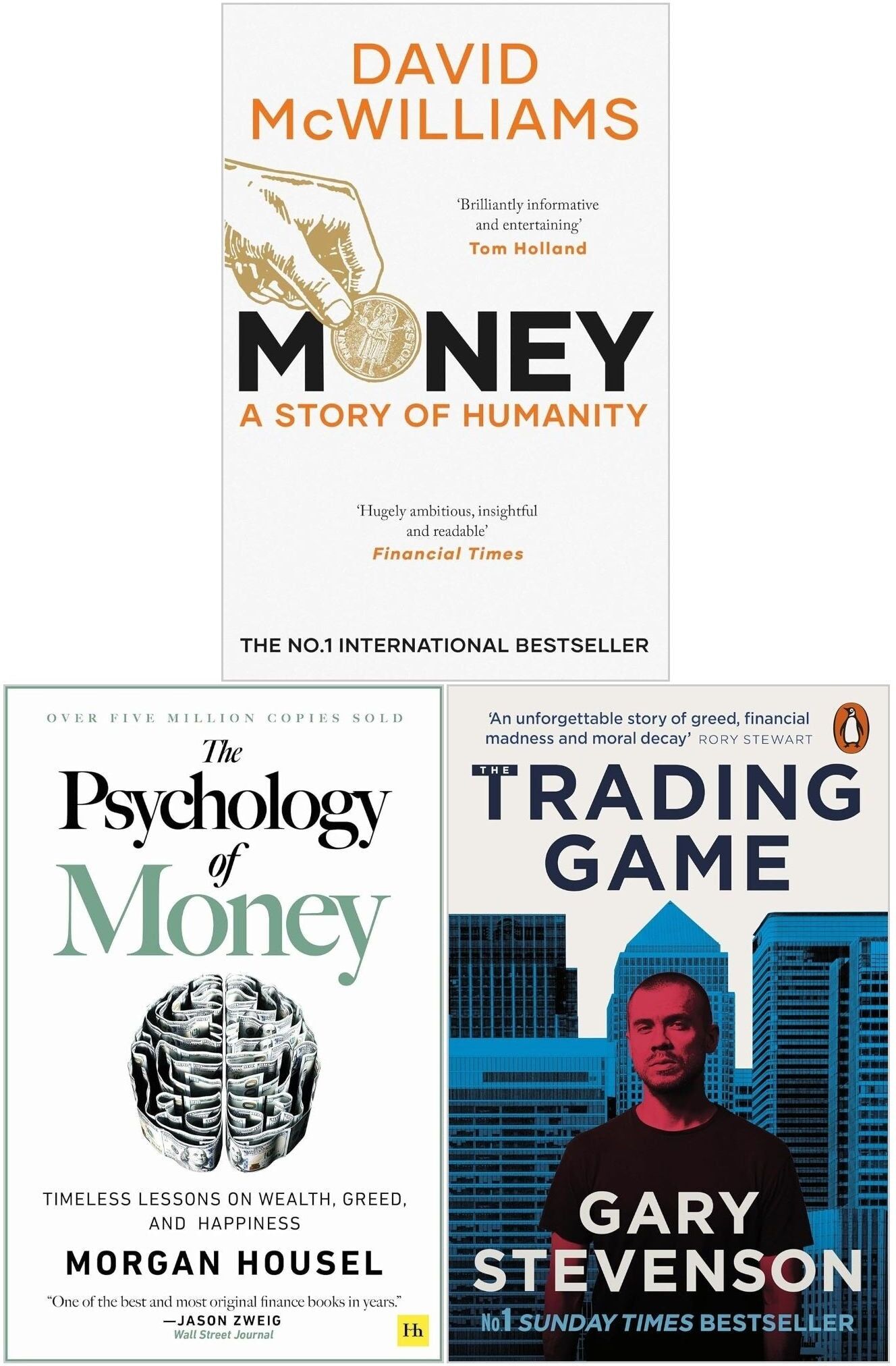
Harriman House Psychology of Money, The Trading Game and Money: A Story of Humanity 3 Books Collection SetPsychology of Money by Morgan Housel Doing well with money isn't necessarily about what you know. It's about how you behave. And behavior is hard to teach, even to really smart people. Money – investing, personal finance, and business decisions – is typically taught as a math-based field, where data and formulas tell us exactly what to do. But in the real world people don't make financial decisions on a spreadsheet. They make them at the dinner table, or in a meeting room, where personal history, your own unique view of the world, ego, pride, marketing, and odd incentives are scrambled together. The Trading Game by Gary Stevenson Ever since he was a kid, kicking broken footballs on the streets of East London in the shadow of Canary Wharf's skyscrapers, Gary wanted something better. Something a whole lot bigger. Then he won a competition run by a bank: 'The Trading Game'. The prize: a golden ticket to a new life, as the youngest trader in the whole city. A place where you could make more money than you'd ever imagined. Where your colleagues are dysfunctional maths geniuses, overfed public schoolboys and borderline psychopaths, yet they start to feel like family. Where soon you're the bank's most profitable trader, dealing in nearly a trillion dollars. A day. Where you dream of numbers in your sleep - and then stop sleeping at all. Money: A Story of Humanity by David McWilliams MONEY. The object of our desires. The engine of our genius. Humanity’s greatest invention. From clay tablets in Mesopotamia to today’s cryptocurrency, global economist David McWilliams takes us on an epic journey of innovation, disruption and transformation that is an astonishing new history of our species. The question is, over 5,000 years, have we changed money – or has money changed us?22,99 £*Shipping: 2,99 £Secure redirect to the provider
-
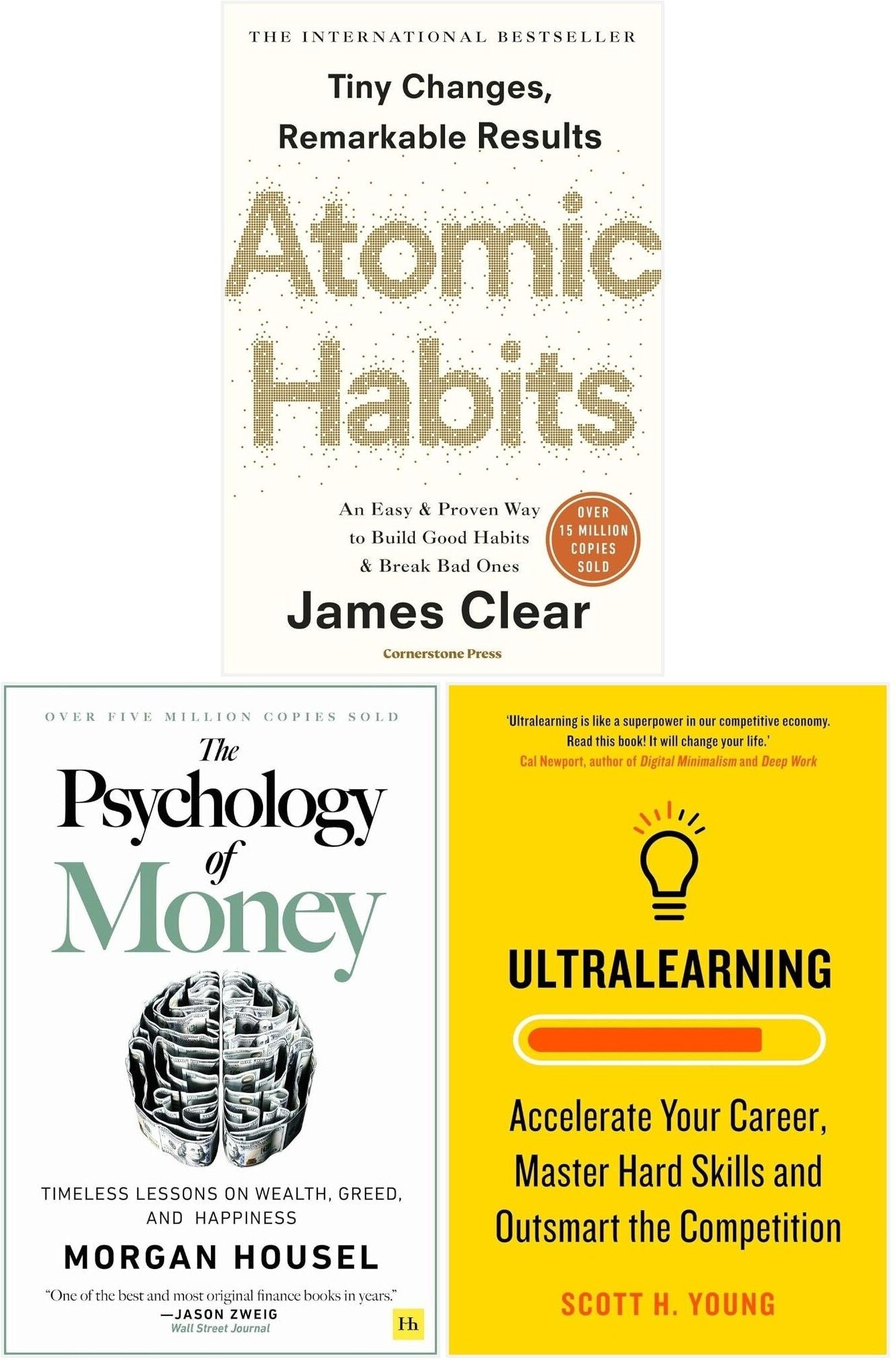
Thorsons/Cornerstone/Harriman House Ultralearning, Atomic Habits and The Psychology of Money 3 Books SetUltralearning Future-proof your career and maximize your competitive advantage by learning the skill necessary to stay relevant, reinvent yourself, and adapt to whatever the workplace throws your way in this essential guide. Faced with tumultuous economic times and rapid technological change, staying ahead in your career depends on continual learning―a lifelong mastery of new ideas, subjects, and skills. If you want to accomplish more and stand apart from everyone else, you need to become an ultralearner. Atomic Habits Transform your life with tiny changes in behaviour, starting now. People think that when you want to change your life, you need to think big. But world-renowned habits expert James Clear has discovered another way. He knows that real change comes from the compound effect of hundreds of small decisions: doing two push-ups a day, waking up five minutes early, or holding a single short phone call. The Psychology of Money Doing well with money isn't necessarily about what you know. It's about how you behave. And behavior is hard to teach, even to really smart people. Money investing, personal finance, and business decisions is typically taught as a math-based field, where data and formulas tell us exactly what to do. But in the real world people don't make financial decisions on a spreadsheet. They make them at the dinner table, or in a meeting room, where personal history, your own unique view of the world, ego, pride, marketing, and odd incentives are scrambled together.29,99 £*Shipping: 2,99 £Secure redirect to the provider
-
How can I deregister my car if I don't have the vehicle registration document or the license plate?
If you don't have the vehicle registration document or license plate, you can still deregister your car by contacting your local Department of Motor Vehicles (DMV) or equivalent authority. You will likely need to provide alternative forms of identification and proof of ownership, such as a bill of sale or a notarized affidavit. The DMV will guide you through the process and may require additional documentation to complete the deregistration. It's important to follow the specific instructions provided by the DMV to ensure the proper deregistration of your vehicle. **
-
What is the significance of the number 10062 in psychology?
In psychology, the number 10062 is significant as it is the number of different possible 5-item scales that can be created from a pool of 20 items. This concept is important in understanding the complexity and variability of psychological measurement. It highlights the vast number of potential combinations and permutations that can be used to assess psychological constructs, emphasizing the need for careful selection and validation of measurement tools in psychological research and practice. **
-
What is the significance of the number 10035 in psychology?
In psychology, the number 10035 is significant because it is the code for the DSM-5 diagnosis of Posttraumatic Stress Disorder (PTSD). The DSM-5 is the Diagnostic and Statistical Manual of Mental Disorders, which is used by mental health professionals to diagnose and classify mental disorders. PTSD is a serious mental health condition that can develop after a person has been exposed to a traumatic event, and the DSM-5 code 10035 is used to identify and diagnose individuals who exhibit the symptoms of PTSD. Therefore, the number 10035 holds significance in psychology as it represents a specific diagnosis within the field of mental health. **
-
Is the car registration plate ST 09 in the middle of the plate not made up of letters and not a government vehicle?
The car registration plate ST 09 is not in the middle of the plate and is made up of letters and numbers, so it is not a government vehicle. The registration plate appears to be a standard civilian vehicle registration plate. **
* All prices are inclusive of VAT and, if applicable, plus shipping costs. The offer information is based on the details provided by the respective shop and is updated through automated processes. Real-time updates do not occur, so deviations can occur in individual cases. ** Note: Parts of this content were created by AI.